
![Can Leopard Geckos Be Kept Together [Truth]](https://reptileopedia.com/wp-content/uploads/2026/06/Can-Leopard-Geckos-Be-Kept-Together-Truth-1024x512.jpg)
The original topic is about leopard geckos living together, so I have rewritten it with relevant reptile-care keywords instead of the unrelated coffee keyword.
Leopard geckos should usually live alone. Although they look calm, friendly, and easy to handle, they are naturally solitary reptiles. In the wild, they do not need a cage mate to feel happy or secure. For most owners, especially beginners, keeping one leopard gecko per enclosure is the safest and healthiest choice.
Can Leopard Geckos Live Together Safely?
Many people think about getting a second gecko after watching videos online or seeing several geckos together in a pet shop. It may look cute to imagine two geckos sharing the same tank, eating together, and resting side by side. However, cohabitation can quickly become stressful or dangerous if the geckos fight, compete for food, or claim the same hiding spot.
Are Leopard Geckos Social Pets?
Leopard geckos are not social animals in the same way dogs, cats, or some birds can be. They do not need a friend, partner, or tank mate to live a healthy life. In fact, another gecko in the same space can make them feel unsafe.
A single gecko with the right temperature, hides, clean water, calcium, live insects, and a safe tank setup can live a comfortable and active life. Instead of adding another gecko, it is usually better to improve the enclosure with more climbing areas, natural hides, and proper heating.
Why Sharing a Tank Can Be Risky
Keeping two leopard geckos together can create several problems. One gecko may become dominant and take the best warm hide, eat more food, or block the other gecko from important areas of the tank. The weaker gecko may hide more often, eat less, lose weight, or become stressed.
Common risks of leopard gecko cohabitation include:
- Territorial behaviour
- Stress
- Biting
- Tail injuries
- Food competition
- Bullying
- Weight loss
- Breeding pressure
- Serious fighting
- Fatal injuries
Even if two geckos seem peaceful at first, their behaviour can change suddenly. A pair that looks fine one week may start fighting the next.
Gender Matters in Leopard Gecko Housing
The sex of each gecko is one of the most important factors when deciding whether they can live together.
Male and Male Leopard Geckos
Two male leopard geckos should never live together. Males are highly territorial and may fight for space, food, hides, and dominance. These fights can lead to severe wounds, dropped tails, stress, or death. Keeping two males in one tank is unsafe.
Male and Female Leopard Geckos
A male and female leopard gecko should also not live together as regular tank mates. The male may try to breed too often, which can stress and weaken the female. Frequent breeding can affect her health, calcium levels, appetite, and overall condition. This pairing should only be managed by experienced breeders with proper knowledge and separate housing plans.
Female and Female Leopard Geckos
Two female leopard geckos may sometimes live together, but it is still risky. Some females may tolerate each other, while others may compete or fight. Even when two females appear calm, they must be watched closely for signs of stress, bullying, food stealing, or injury. For beginners, separate tanks are still the better option.
Important Things to Consider Before Cohabitation
If an experienced keeper chooses to house two females together, several points must be checked carefully.
1. Their History Together
Geckos that have lived together peacefully from a young age may have a better chance of tolerating each other. However, this does not guarantee safety. A change in age, size, hormones, or environment can still cause problems.
2. Tank Size and Resources
A shared leopard gecko enclosure must be much larger than a normal single-gecko tank. Each gecko needs access to its own warm hide, cool hide, moist hide, food area, and safe resting space. Without enough resources, one gecko may dominate the tank.
3. Similar Size and Strength
Two geckos should never be housed together if one is much bigger than the other. A larger gecko can easily bully, bite, or outcompete the smaller one. Size differences can make feeding and safety harder to control.
4. Age and Sexual Maturity
Young geckos and adult geckos should not be mixed. Their needs are different, and the size gap can be dangerous. A baby leopard gecko should never live with an adult because it may be harmed, stressed, or prevented from eating properly.
Can Baby Leopard Geckos Live With Adults?
No, a baby leopard gecko should not live with an adult leopard gecko. Adult geckos are stronger, larger, and more dominant. A baby may become stressed, lose access to food, or get injured. Young geckos should be kept in their own secure enclosure where their feeding, growth, and health can be monitored properly.
Separate Tanks Are Usually Better
Keeping leopard geckos separately is the safest choice. It reduces stress, prevents fighting, and makes health care much easier. When each gecko has its own enclosure, you can clearly see how much it eats, how often it sheds, whether it is pooping normally, and whether it is behaving in a healthy way.
Separate housing also helps prevent confusion. If two geckos live together and one becomes sick, it can be hard to know which gecko is not eating or which one has abnormal droppings.
Cohabitation Does Not Always Save Space
Some owners think one large tank will save space compared to two smaller setups. In reality, a shared tank must be large enough to provide separate areas for each gecko. It also needs extra hides, feeding spaces, and careful monitoring. Because of this, cohabitation often does not save much space or effort.
In many cases, two separate enclosures are safer, cleaner, and easier to manage.
Do Leopard Geckos Need a Friend?
Leopard geckos do not need a friend to feel happy. They are comfortable living alone when their enclosure is properly set up. A good habitat, correct heating, safe hides, fresh water, proper diet, and gentle handling are far more important than another gecko.
Your gecko will not feel lonely like a human. It will feel safest when it has a peaceful territory of its own.
Can Leopard Geckos Spend Time Together Outside the Tank?
Even outside the enclosure, leopard geckos should be handled carefully and separately. Short, supervised time outside the tank may be safe for individual geckos, but placing two geckos together is not necessary. They may still become stressed, defensive, or aggressive.
If you own more than one gecko, give each one separate handling time. This keeps them calm and reduces the risk of sudden fighting.
Is There Any Benefit to Keeping Two Leopard Geckos Together?
There are very few real benefits to keeping leopard geckos together. Some owners may enjoy seeing more than one gecko in the same tank, but this is mainly for the owner, not the animals. For the geckos, shared housing often increases the risk of stress, competition, injury, and health problems.
Age and Sexual Maturity
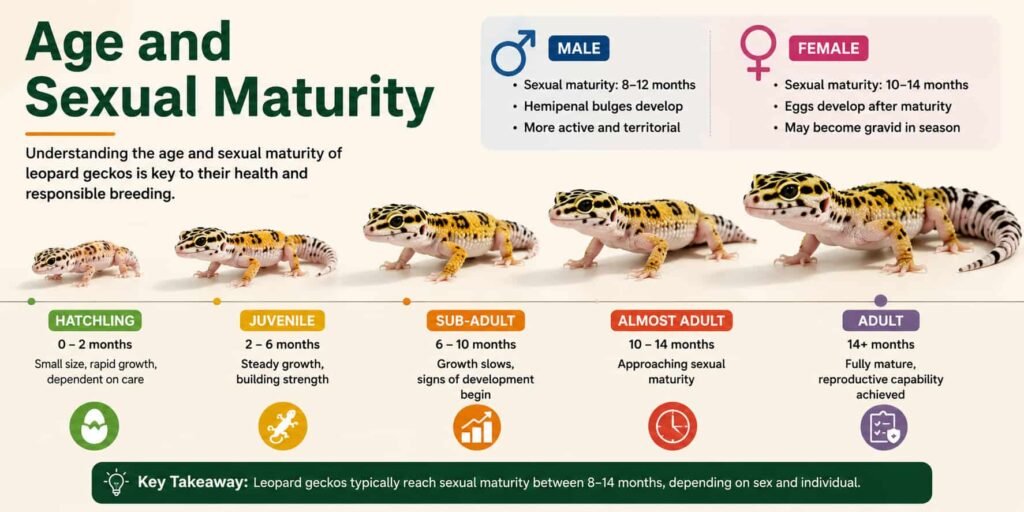
Sexual maturity can change a leopard gecko’s behaviour. Young geckos may seem calm at first, but as they grow, their hormones can make them more territorial or aggressive. This is especially common in males.
Leopard geckos usually become sexually mature when they are around 18 to 24 months old, although weight is often a better guide than age. Many reach maturity at around 35 grams. Once mature, they may start showing stronger territorial behaviour, breeding interest, and competition.
This means a peaceful pair of young geckos may not stay peaceful forever. Owners must keep watching their behaviour as they grow. If chasing, biting, food stealing, hiding, or weight loss begins, the geckos should be separated immediately.
Best Housing Options for Multiple Leopard Geckos
Owners who keep more than one leopard gecko have two main choices: shared housing or separate housing. In most cases, separate housing is the safer and more responsible option.
Shared Housing
In rare cases, experienced keepers may house compatible female leopard geckos together in a large, well-designed vivarium. A spacious enclosure can help reduce conflict because each gecko has room to move, hide, eat, and rest without being forced into constant contact.
However, shared housing needs careful planning. The tank must include multiple hides, proper heating, safe temperature zones, clean water, and separate feeding areas. The geckos must also be monitored regularly for signs of stress, bullying, injury, or food competition.
Even when the setup looks suitable, things can change quickly. A pair that seems calm one day may begin fighting later. For this reason, owners should always have a backup enclosure ready in case the geckos need to be separated.
Separate Housing
Separate housing is the safest option for most leopard gecko owners. When each gecko has its own tank, there is no competition for food, heat, hides, or territory. It also becomes easier to track each gecko’s eating habits, shedding, droppings, weight, and general health.
Separate enclosures reduce the risk of fighting and make the geckos feel more secure. Since leopard geckos are naturally solitary reptiles, they do not need a tank mate to feel happy or healthy.
Keeping Leopard Geckos in Separate Enclosures
If you own more than one leopard gecko, separate housing is usually the safest option. A practical way to save space is to use a vivarium stack. This setup allows each reptile to have its own enclosure while the tanks are placed neatly on top of each other.
A vivarium stack is useful for reptile keepers who own several animals, such as leopard geckos, bearded dragons, or other small reptiles. It gives each pet its own territory, which helps reduce stress, territorial behaviour, and fighting. Since leopard geckos are naturally solitary reptiles, separate housing supports their normal behaviour and makes daily care easier.
With individual tanks, each gecko can have its own warm hide, cool hide, moist hide, food bowl, water dish, and safe resting space. This creates a healthier and more controlled environment for every reptile.
Can a Baby Leopard Gecko Live With an Adult?
A baby leopard gecko should not live with an adult leopard gecko. The size difference can be dangerous. Adult geckos may see smaller animals as food or may injure them by accident during feeding or movement.
Even if the adult does not try to harm the baby, it may still take most of the food, claim the best hiding spots, or block access to warm areas. This can cause the baby gecko to become stressed, weak, or underweight.
Young geckos should be kept in their own secure enclosure. This makes it easier to monitor their growth, feeding habits, shedding, weight, and overall health. For safety, baby and adult leopard geckos should always be housed separately.
Why Cohabitation May Not Save Space
Many owners think keeping two leopard geckos together will save space, but this is often not true. A shared tank must be much larger than a normal single-gecko enclosure. It also needs extra hides, feeding areas, water access, and temperature zones.
Each gecko needs enough room to feel safe and avoid constant contact with the other. Without enough space, one gecko may become dominant and the other may suffer from stress, food competition, or lack of access to heat.
In many cases, two separate enclosures placed on a shelf or in a vivarium rack can save space better than one oversized shared tank. Separate tanks also match the natural lifestyle of leopard geckos because they prefer living alone.
Why Shared Housing Makes Health Checks Harder
Keeping two leopard geckos in one enclosure can make health monitoring more difficult. If you find unusual droppings, blood, or signs of illness in the tank, it can be hard to know which gecko has the problem.
Feeding can also become difficult to track. One gecko may eat more insects while the other eats less. Over time, the weaker gecko may lose weight or become less active. This can happen quietly, especially if one gecko is more dominant during feeding.
Separate housing makes it much easier to check each gecko’s appetite, weight, poop, shedding, and behaviour. This helps owners notice health problems early and take action before the issue becomes serious.
Leopard Gecko Behaviour Can Change Quickly
Even if two leopard geckos seem peaceful at first, their behaviour can change without warning. They may live together calmly for days, weeks, or even months, but a fight can suddenly happen over food, space, heat, or hiding spots.
Because owners cannot watch their geckos all day and night, injuries can happen when no one is around. A sudden fight may lead to bites, dropped tails, stress, expensive vet treatment, or even death.
For this reason, anyone attempting leopard gecko cohabitation should always have a backup enclosure ready. If the geckos show signs of aggression, bullying, stress, or injury, they must be separated immediately.
Do Leopard Geckos Need a Companion?
Leopard geckos do not need a friend to stay happy. They are not social animals that depend on a group or partner. In the wild, they usually live alone and focus on survival, hiding, hunting, and protecting their own space.
It is easy for owners to think their gecko may feel lonely, but leopard geckos do not need another gecko for comfort. In fact, another gecko in the same tank may cause more stress instead of making them feel safe.
A leopard gecko is more likely to thrive when it has a peaceful enclosure, proper heating, clean water, safe hides, and a healthy diet of live insects.
Are There Any Real Benefits to Keeping Two Leopard Geckos Together?
There are very few real benefits to keeping two leopard geckos together. Some owners may like the idea because it looks interesting or makes good photos, but it is usually better for the owner than for the geckos.
Shared housing requires more space, more hides, more feeding areas, and closer monitoring. It also increases the risk of stress, dominance, injury, and health problems. For most keepers, the risks are greater than the benefits.
The safest choice is to keep each leopard gecko in its own enclosure. This allows every gecko to eat, rest, shed, and behave naturally without competition.
Living Together vs Supervised Time Outside the Tank
There is a difference between permanently housing leopard geckos together and allowing them to be near each other for a short time outside the tank. A shared enclosure is a limited space, so geckos may feel trapped or territorial. This can increase the chance of conflict.
Supervised time outside the tank is different because the space is usually wider and easier to control. However, it still requires close attention. Leopard geckos may walk away quickly, fall from furniture, or become stressed by another gecko nearby.
If two geckos are taken out at the same time, they should always be watched carefully. It is usually safer to handle them separately so each gecko stays calm and secure.
Final Thoughts
Leopard geckos can sometimes live together in rare situations, but they usually should not. Males should never be housed together, and male-female pairs should not share a tank unless managed by an experienced breeder. Even female pairs can become stressed or aggressive.
The safest option is to keep each leopard gecko in its own properly heated and well-designed enclosure. This gives your pet more comfort, better health, and a lower risk of injury. A leopard gecko does not need a tank mate to thrive. It needs a safe home, good food, clean water, correct temperatures, and calm care from its owner.
FAQs: Can Leopard Geckos Be Kept Together?
Is it okay to have two leopard geckos together?
No, it is usually not safe to keep two leopard geckos together. They are solitary reptiles and can become territorial, stressed, or aggressive in a shared enclosure. For better health and safety, each leopard gecko should have its own separate tank.
Do leopard geckos like to be together?
No, leopard geckos do not usually like living together. They are solitary reptiles and prefer their own enclosure. Sharing a tank can cause stress, territorial behaviour, fighting, food competition, and serious injuries.
Can geckos be kept in pairs?
It depends on the gecko species, gender, tank size, and behaviour. However, solitary geckos, such as leopard geckos and crested geckos, should usually live alone. Keeping them in pairs can cause stress, territorial fights, food competition, injuries, or even death.
Are geckos better alone or in pairs?
Most geckos are better kept alone because many species are territorial reptiles. When housed together, they may fight, bite, scratch, drop their tails, or compete for food, hiding spots, heat, and tank space. A separate enclosure helps reduce stress, prevents injuries, and keeps each gecko healthier and safer.
Can geckos hear you?
Yes, geckos can hear sounds and feel small vibrations. Their ears can detect higher sounds, while a special inner-ear part called the saccule helps them sense low-frequency movement. This means your pet gecko may notice your voice, footsteps, or sounds around its enclosure, even if it does not respond like a dog or cat